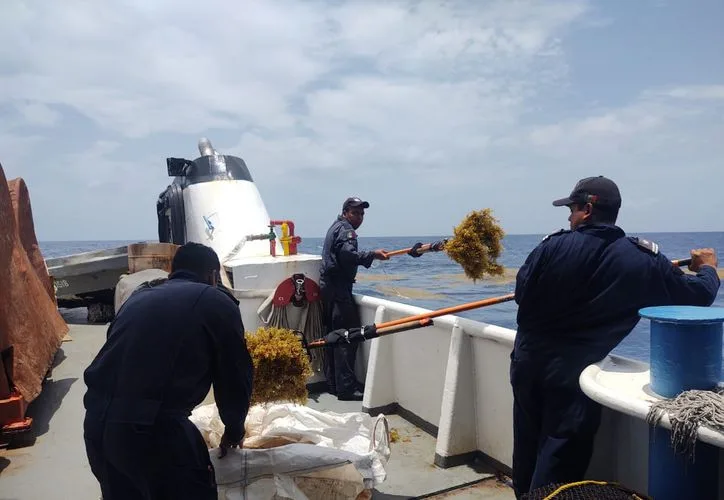
Cancún, Quintana Roo — Facing technical challenges with fixed barriers along parts of its coast, the Benito Juárez municipality is evaluating the use of collection barges to intercept sargassum seaweed before it reaches shore.
The strategy responds to oceanographic conditions in the area from Playa Ballenas to Chac Mool, where strong waves and currents prevent traditional containment barriers from remaining stable. The measure aims to protect critical points in the hotel zone, allowing for more efficient marine cleanup just before the macroalgae reaches the surf zone and accumulates on Cancún’s beaches.
Benito Juárez Mayor Ana Paty Peralta confirmed that a prior analysis determined barriers are not a viable option in certain sectors. The current focus is on specialized vessels. “What affects us most is when it reaches the beach because, although there is great work by the Public Services team and the Federal Maritime Zone, it does take away some sand and there can be erosion of our beaches,” the mayor explained, emphasizing that the main goal is to avoid environmental impact and sediment loss that occurs during land-based cleanup operations.
To implement this project, the municipal government plans to coordinate with the State Secretariat of Environment (SAMA). Its head, Oscar Rébora Aguilera, recently noted that barriers still cannot be installed in Cancún due to currents, but their specific placement at Playa Coral is under study.
Regarding barge logistics, the mayor’s proposal considers signing agreements with the Mexican Navy (Semar), evaluating whether renting this type of infrastructure is preferable to continuing with machinery for collection on the beaches. “The option has been given to rent the machinery; better to do it at sea,” the mayor stated, highlighting that removal will be prioritized in high-wave areas where logistics are more complex.
She detailed that while these agreements and vessel contracts are being finalized, cleanup work continues daily through the Federal Maritime Terrestrial Zone (Zofemat). The mayor maintains constant monitoring of beach conditions to optimize available resources. “Zofemat informs me every morning about the sargassum status, and depending on that, protocols and teams are activated,” she concluded.
Data
Cancún
- 16,654.48 tons of sargassum were removed in 2025
Three beaches with most accumulation
- Playa Delfines: 13,688.48 cubic meters
- Playa Coral: 6,096.45 cubic meters
- Playa Chac Mool: 2,163.30 cubic meters
Critical months
- July: 2,497.64 tons
- August: 6,718.69 tons
- September: 2,848.21 tons
Discover more from Riviera Maya News & Events
Subscribe to get the latest posts sent to your email.