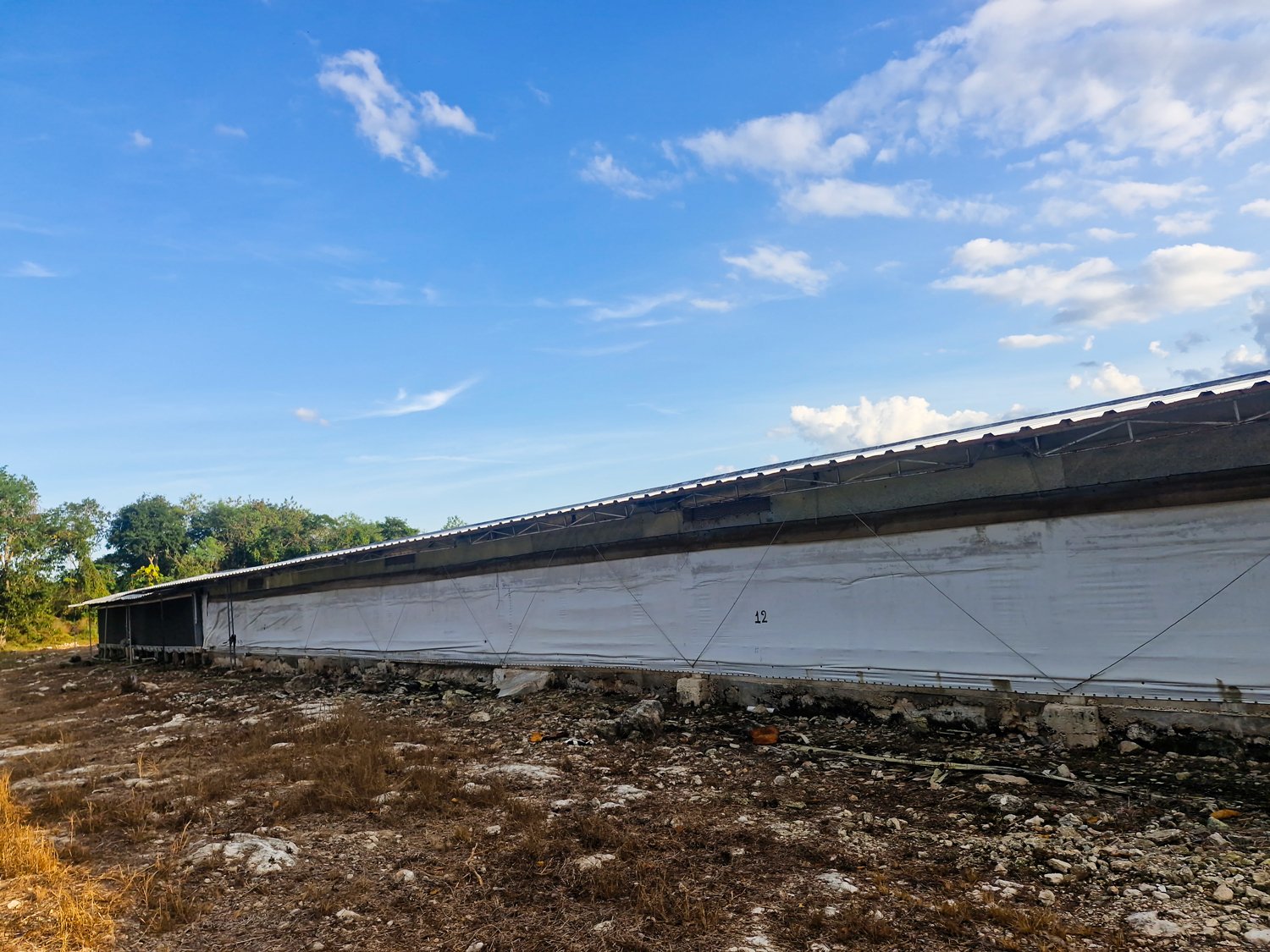
Yucatán, Mexico — On December 26, the Federal Attorney for Environmental Protection (Profepa) temporarily closed two mega chicken farms operated by Bachoco, one of the world’s largest poultry companies. According to authorities, the company had deforested 23 hectares of jungle without authorization at Hacienda Teya, located in the municipality of Kanasín, northwest Yucatán.
Some residents found this closure—resulting from an “anonymous citizen complaint”—strange because there was no evident deforestation activity, while others applauded Profepa’s action, claiming that projects like these farms are “depredating” the jungle.
EL CEO found that this deforestation did not occur recently but over 40 years ago by a company that was acquired by Bachoco in 2001. However, during these decades, Profepa had not spoken out about it.
What is currently happening in Yucatán is a series of accusations against Bachoco and other poultry companies for allegedly using clandestine dumps in the jungle, where tons of chicken excrement, also known as gallinaza, have been abandoned.
The Silent Expansion of Bachoco
There are no environmental permits from Bachoco available on the National Transparency Platform, the Yucatán Secretariat of Sustainable Development, or the Secretariat of Environment and Natural Resources (Semarnat), despite the law requiring them when there is a change in land use, deforestation, and threat to the ecosystem, among other things.
This outlet only detected one environmental impact study for one of its farms in the Yucatecan municipality of Peto, which outlines, among other things, environmental mitigation measures for the surroundings and even the “benefits” to the population.
Although there is no clarity about its environmental management, Bachoco is present in at least 17 municipalities in the state of Yucatán, as EL CEO detected via satellite.
In 2020, the company had at least 127 sheds, using 61.7 hectares of land in Yucatán dedicated to its poultry activity, according to a study by the collective Geocomunes, which has accompanied collective struggles in that region.
Only in 2026, Bachoco has secured more than 8 million cubic meters of water from the Yucatán aquifer for its farms and processing plants, according to 54 concessions available in the database of the Public Registry of Water Rights (REPDA). It is one of the 10 companies with the most water exploitation rights in that entity.
This expansion occurs in a context where Yucatán ranked nationally as the second state with the most growth in chicken meat production—4.6%—and table egg production—3.6%—according to data from the Secretariat of Agriculture and Rural Development presented last December in its Panorama Agroalimentario 2025 report.
Profepa Arrives 40 Years Late
After Profepa’s announcement about deforestation on 23 hectares at its farms, EL CEO attempted to locate the cleared lands using satellites from the Copernicus program—for terrestrial, oceanic, and atmospheric monitoring of Earth—and Google Earth, but no apparent damage was detected within Bachoco’s complex, although there was on adjacent lands.
When questioning Profepa about the damaged property, the agency responded that the impact was detected at the Teya 5 and Teya 6 farms; however, these were built in 1975, when the company Avícola del Sureste, S.A. de C.V. operated, which was absorbed by Bachoco in 2001.
Despite arriving four decades late, Profepa responded to EL CEO that it accredited: “the existence of an imminent risk of ecological imbalance, as well as serious damage or deterioration to natural resources.”
However, and despite the findings, the environmental attorney’s office has not filed a criminal complaint for the damages. It only added that the closure is even reversible.
‘They Are Not Looking Where the Disaster Is’
A source close to the case told EL CEO that this closure at the Teya farms in Kanasín occurs in a context where residents have reported to local and federal authorities the operation of clandestine gallinaza dumps, coming from large poultry companies.
According to the source, environmental inspectors are not looking at the main impacts of the poultry industry.
“It’s ridiculous, suddenly this closure of the Teya farm appears, which is not on the map; I doubt that place doesn’t have permits, it’s a very old farm, and it has nothing to do with this disaster (of clandestine dumps) that has been exposed,” declared the source.
The Jungle as a Dump
Since 2024, residents of the Yucatecan municipalities of Kinchil and Halachó have denounced and reported to local and federal environmental authorities the appearance of at least eight clandestine dumps where poultry companies allegedly abandon excrement—also known as gallinaza.
The alerts have increased due to fear that this material could filter into the Yucatán Peninsula aquifer, the largest in Mexico, which connects hundreds of cenotes. However, in the last two years, Profepa has only reported at least two closures in the area, where deforestation occurred to serve poultry industry activities.
The latest sanction occurred on January 13, on a deforested property used by the poultry company Productora Nacional de Huevo S.A. de C.V., whose trade name is CRÍO. Profepa even filed a criminal complaint, as the company removed the seals from the machinery and continued with the works.
Residents have denounced that at some of these illegal properties they have noticed the presence of vehicles with Bachoco’s logo, and from the company Biosoluciones y Ciencia S.A. de C.V., dedicated to gallinaza management, which on its Facebook page claims to be a supplier of that poultry company.
Bachoco’s Response to Allegations
EL CEO requested a position on this and other allegations from Bachoco, who did not respond with clear details about the clandestine dumps but assured that it operates under standards and protocols aimed at responsible process management, “with emphasis on control, monitoring, and prevention of impacts.”
“Productive development must advance responsibly, in adherence to the law, with respect for the natural environment and the communities where it operates,” it stated.
However, and although in its 2024 sustainability report it reiterates its concern for environmental conservation, it does not report specific measures that respond to the sustainable treatment of its waste, such as the incorporation of biogas plants, which could transform excrement into electricity.
Chickens Do Not Go to Water
The abandonment of chicken excrement—which is also a crime according to the Federal Penal Code—has received allegations from the population due to the bad odor, although, according to the United Nations Food and Agriculture Organization (FAO), poultry waste also has other environmental and health impacts:
- It contaminates the air through the gases it releases, which increases the risk of respiratory diseases.
- It seriously damages soil fertility due to excess ammonia.
- It increases the presence of flies, threatening beekeepers’ hives.
- Due to the soil type, it filters into drinking water bodies and contaminates them.
In the battles for water and territory against poultry companies, the story of Miguel Ángel Canul Gómez is inserted, an ejidatario from the municipality of Hunucmá dedicated to agriculture, who suffered threats allegedly from Bachoco workers because his plot interferes with its expansion, according to the investigation by journalist Claudia V. Arriaga Durán, published in Pie de Página.
Bachoco did not give details of the event in its response to EL CEO but said that such actions do not align with its values, but that it “always prioritizes institutional dialogue and legal channels.”
Bachoco ‘Does Not Lose’
For three decades, Bachoco has announced a series of million-dollar investments in various municipalities of Yucatán for breeding farms, hatcheries, and processing plants. In this biodiverse territory, which investors describe as a “fertile destination” for the industrial sector, the poultry company has expanded to supply foreign demand for its products.
The temporary closure at Hacienda Teya is not the only company project that has clashed with the interests of the Yucatecan population and indigenous communities defending the peninsula’s jungle.
In November 2023, a judge ordered the suspension of the Akutzá Farm because the project threatened to contaminate the water of an indigenous Maya community; additionally, the organization Proyecto de Derechos Económicos, Sociales y Culturales (ProDESC) highlighted that there was no prior consultation with the peoples inhabiting the area, a common practice in the installation of projects on the peninsula that EL CEO has documented.
Although in the Environmental Impact Statement (MIA) of the Akutzá Farm they promised adequate management of waste from their farms, ProDESC pointed out that there was a high risk that, due to its proximity, the waste would contaminate Laguna Chichankanab “the largest inland freshwater body of the Yucatán Peninsula, declared a Ramsar Site by UNESCO in 2004,” assured the organization.
With help from local Yucatán rulers, the plant was inaugurated in February 2024. One of the promises is that Bachoco would invest 1.1 billion pesos in the project and leave 310 direct jobs.
Bachoco, the Business That Began with a Chicken
The company was founded by the Robinson Bours family in Ciudad Obregón, Sonora, in 1952. Almost two decades later, it established its Corporate Headquarters in Celaya, Guanajuato—where it remains—and in 1999 expanded its presence to the Yucatán Peninsula with the purchase of an animal feed company, known as CAMPI.
In its latest 2024 annual report, it describes itself as the leading company nationally and among the ten most important producers worldwide. It has operations in Mexico and the United States, where it totals over 40,000 workers, of which 36,049 are located in Mexico.
In 1997, it became the only Mexican public poultry company with its entry to the Mexican Stock Exchange (BMV); but it delisted its shares in 2024 and later liquidated its debt to stop trading, thus ceasing to be obligated to present financial reports to investors or stock authorities.
Discover more from Riviera Maya News & Events
Subscribe to get the latest posts sent to your email.