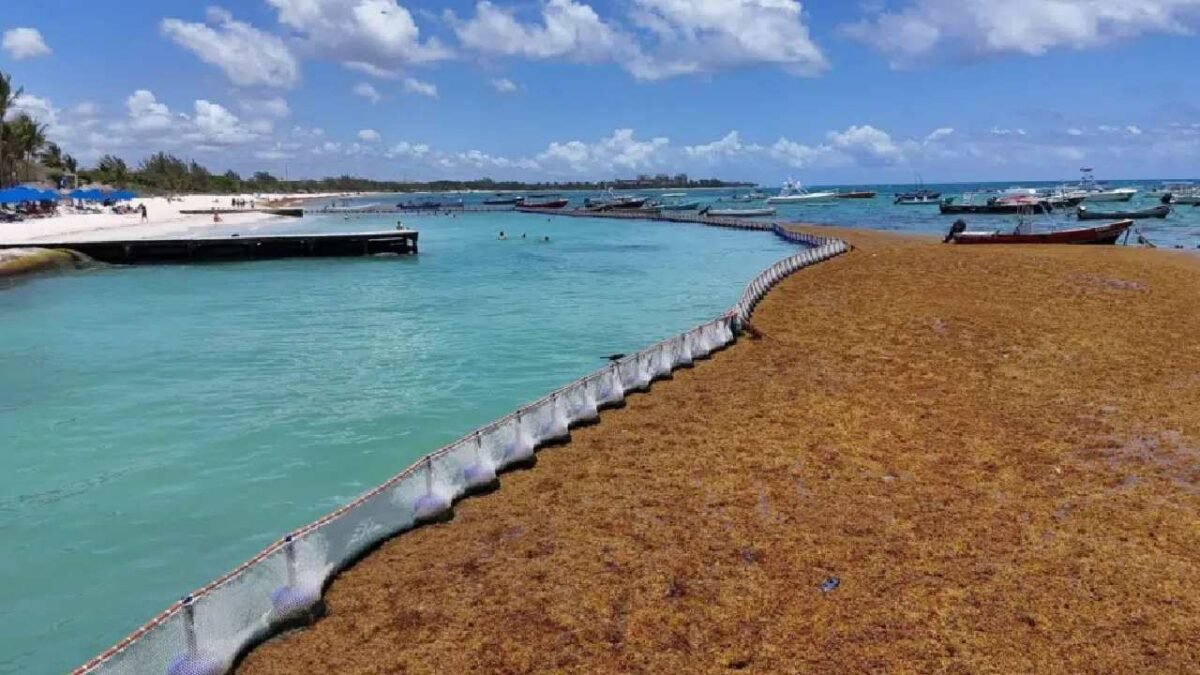
Quintana Roo, Mexico — Authorities are analyzing interconnecting anti-sargassum barriers as part of a comprehensive strategy to address the 2026 sargassum season.
They are examining the interconnection of barriers installed by the State Government with those currently operated by hotels and tourist complexes.
This aims to create continuous protection zones that more effectively reduce the arrival of the algae to the beaches of the Mexican Caribbean.
Authorities Analyze Interconnecting Anti-Sargassum Barriers to Avoid “Windows” of Entry
Greater Coverage and Efficiency in Anti-Sargassum Barriers
The proposal was announced by Esteban Amaro, coordinator of the Sargassum Monitoring Center.
He explained that this scheme would improve barrier performance, expanding their coverage and preventing sargassum from finding “windows” through which to enter the coastal zone.
More Than 7,500 Meters of New Barriers at Strategic Points
Playa del Carmen, Puerto Morelos, Tulum and Mahahual, Priority Zones
For the 2026 season, the installation of more than 7,500 meters of new anti-sargassum barriers is planned, considered more efficient due to their biomass retention capacity.
These structures will be added to or replace existing sections in Puerto Morelos, Playa del Carmen, Tulum and Mahahual.
“The idea is to connect the new barriers with those that some hotels already have, especially in Playa del Carmen and Puerto Morelos, to form a large continuous barrier that has better performance and provides greater protection to the coast,” explained Amaro.
Public-Private Coordination to Optimize Resources
The specialist emphasized that this collaboration between the public and private sectors represents a relevant advance in sargassum management.
It allows optimizing resources, reducing operational costs and improving the effectiveness of preventive actions, particularly in areas with high tourist influx.
Real-Time Monitoring and Interinstitutional Coordination
The project is being developed jointly with the Navy Secretariat, the Ecology and Environment Secretariat (SEMA), ZOFEMAT and coastal municipalities.
This is in addition to the support of real-time monitoring conducted by the Sargassum Environmental Monitoring Center.
The monitoring allows anticipating the arrival of the main algae masses between April and May.
Environmental and Tourist Impact Under Observation
Esteban Amaro noted that in the Caribbean Sea, more than 7,200 tons of biomass are currently estimated.
However, only a reduced percentage reaches the beaches, and the strategic placement of interconnected barriers could make a significant difference.
Particularly in reducing the environmental, economic and tourist impact.
Finally, he highlighted that this collaboration model could become a national and international reference.
Especially for integrating governmental and private efforts to confront a phenomenon that has intensified due to climate change and rising sea temperatures.
Discover more from Riviera Maya News & Events
Subscribe to get the latest posts sent to your email.