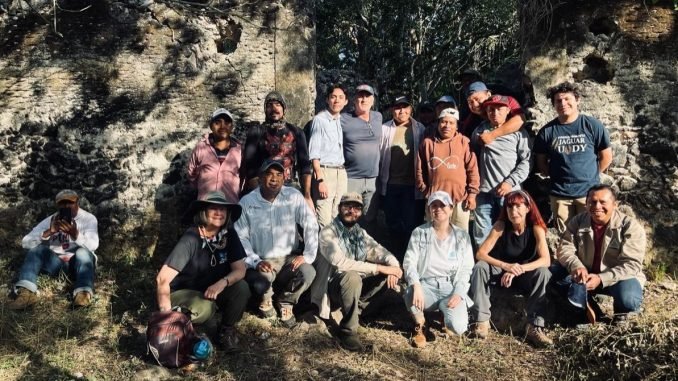
Mérida, Yucatán — Archaeologists from the Autonomous University of Yucatán (UADY) and Spain are advancing research at the Xbaatún archaeological zone, located in Tekal de Venegas.
“There are important advances, as we have conducted drone flights, photogrammetry, topography, and work on a ranch located within the site that dates from the late 19th to early 20th century,” said archaeologist Juan García Targa, who along with ceramic specialist Carmen Varela Torrecilla directs the Xbaatún Project.
From December 1 to 12, archaeologists, students, and ejidatarios from Tekal de Venegas conducted surface surveys with GPS documentation of structures and test pits to better understand the pre-Hispanic site Xbaatún, which in the Mayan language means “Place where water is collected.”
“This year’s work allowed us to understand the structural level of the buildings, understand what they are like, the occupation, know the chronology, and identify the ceramics to pinpoint the moment of occupation and use,” García Targa stated.
Xbaatún, located between Tekal de Venegas and Dzoncauich, is an ideal place for hiking enthusiasts who will enjoy walks through the medium jungle of Yucatán, crowned by aguadas, a cenote with blue waters, and Mayan palaces and temples.
Researchers have been able to interpret this year, based on the results of the test pits, how the Maya might have paved their streets and ceremonial center.
“They would not be of lime or stucco, as in many Mayan cities; we presume that, to overcome the unevenness of the slab, they placed flat stones and on top of these a layer of red earth; that would be what they walked on in their daily life,” he indicated before traveling to Barcelona.
Accompanied by Mexican archaeologists Géiser Martín, Héctor Hernández, and Candy Bermeo and Spanish researcher and historian Xavier Sicart Chavarría, he reported that several sites were also surveyed, specifically a very interesting one: structure 13, documented last year in a courtyard, near a small pyramid that could correspond to a domestic complex.
“That place we still need to explore better and will be one of the sites to work on for the 2026 season,” he assured.
Archaeologist García Targa reported that this year they found ceramics in some of the pits they explored and other elements, such as obsidian flakes, which is a volcanic stone that does not exist in Yucatán, so it had to be brought from Guatemala or central Mexico.
The team found flint, a flint scraper, fragments that possibly belong to a modeled clay human figurine, possibly from the Postclassic period, from 1000 to 1200 AD.
Discover more from Riviera Maya News & Events
Subscribe to get the latest posts sent to your email.