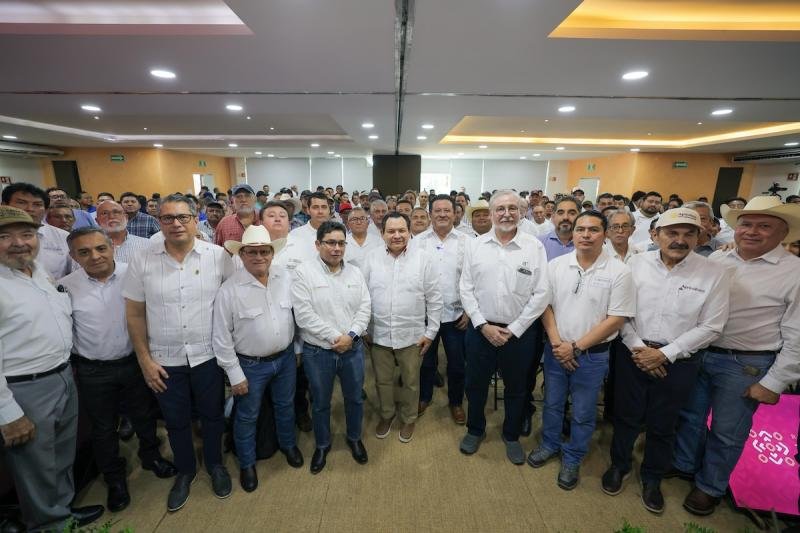
Yucatán, Mexico — Governor Joaquín Díaz Mena presented the Pilot Plan for the Suppression of Cattle Screwworm, aimed at more precisely containing the advance of the pest, strengthening prevention, and improving response capacity to any outbreak, consolidating Yucatán as a national reference in combating this and other diseases affecting the livestock sector.
The governor led the launch of this comprehensive sanitary policy instrument, in coordination with the National Service for Agrifood Health, Safety, and Quality (Senasica) and the Government of Yucatán, to articulate actions focused on reducing populations of the fly responsible for cattle screwworm, thereby contributing to its control and eradication.
“Today is a very important day and fills us with optimism, because this pilot plan for screwworm suppression represents the decision to confront the problem with information, work, and presence of our veterinarians in the territory, with a well-organized strategy that can be replicated by the presidents of livestock associations with their members,” he stated.
The governor noted that screwworm is a pest that threatens livestock productivity and health; therefore, from the first moment, his government decided to socialize information, explain the problem, act accordingly, and build a joint response.
“We hired veterinarians, acquired medications and kits to visit ranches, provided free treatments, strengthened the technical team, and incorporated vehicles to attend to different regions of the countryside, with immediate response to reports. More than 1,300 cases have been attended without a single animal death recorded due to this cause. According to the Senasica report, as of December 6, there were only 86 active cases of cattle screwworm,” detailed the state executive.
Díaz Mena indicated that this is no coincidence, as during this year more than 77 million pesos are being invested in livestock health, with state and federal resources that translate into actions in the territory. He also highlighted the support and accompaniment of President Claudia Sheinbaum Pardo.
“We will defend Yucatecan livestock because defending the countryside is also defending our identity and the heritage of our ancestors. We will not allow abandonment to return to the Yucatecan countryside; here there is a Governor who understands, listens, and walks together with livestock producers. We will fight cattle screwworm and we will win that fight by working as a single team and striving to end this pest as soon as possible,” concluded the state leader.
For his part, the director in chief of Senasica, Francisco Javier Calderón Elizalde, indicated that with this pilot plan, Yucatán becomes a pioneer of a livestock health model that aspires to be a reference throughout the south-southeast region of the country, and that the lessons learned in Yucatecan soil will guide scaling the strategy nationally.
“This plan is not just an intention document prepared at a desk, but the implementation of concrete actions aimed at obtaining tangible results that benefit producers; moreover, it is a demonstration that first-level technical knowledge can and should translate into real solutions to reduce risks, protect agrifood production, and provide certainty to the countryside,” he emphasized.
In his intervention, the general director of Animal Health of Senasica, Gabriel Ayala Borunda, recognized Yucatán’s leadership in livestock production and health, which has allowed it to achieve a zoosanitary status to compete successfully in more demanding markets, both national and international.
“Due to its technical capacity and strategic conditions, Yucatán has been selected as the spearhead for this pilot plan. We find here the conditions to implement it. We will use adult suppression traps and bait stations, alternatives that have been rigorously evaluated, with very promising preliminary results,” he added.
He explained that the objective of this pilot plan is to reduce the density of screwworm flies, in order to prepare the ground for a future massive release of sterile flies produced in Mexico. He specified that for the sterile fly to be effective, there must be 10 of them for every fertile fly.
When presenting the details of the pilot plan, the director of Integration and Intelligence Analysis of Senasica, Rigoberto González Gómez, indicated that it seeks to: avoid the dispersion and establishment of the pest; interrupt its biological cycle to directly protect livestock; eliminate larvae to prevent new generations of flies and reinfestation of areas; and suppress the adult population of wild flies in specific sites where aggregations form, in order to inhibit reproduction.
Likewise, he noted that as part of this instrument, communication will be strengthened through informational campaigns to sensitize producers and ensure timely notification; in addition, rapid interventions will be carried out for suspected and confirmed cases, guaranteeing the sending and diagnosis of samples, immediate implementation of care and treatment measures, and interinstitutional coordination for epidemiological containment.
He added that the operation will include trap placement, training, dissemination, technical registration, and follow-up meetings, in order to promote the active participation of producers.
Therefore, field actions are contemplated that include the identification of strategic sites, trapping and entomological suppression activities, and supervision of the technical team through the placement of bait stations and application of treatments for myiasis; in addition, livestock groups will be integrated for pest suppression, control points will be installed in the Peninsula, and veterinary inspections and case notification will be incorporated.
Present at the event were the Secretary of Rural Development, Edgardo Medina Rodríguez; the technical coordinator of the Senasica Operational Fly Program, José Luis Quintero Fong; the president of the Governing Board and Political Coordination of the Yucatán State Congress, Wilmer Monforte Marfil; the head of the Office of the Representation of the Ministry of Agriculture in Yucatán (Sader), Jorge Carlos Berlín Montero; the rector of UADY, Carlos Alberto Estrada Pinto; the president of the Regional Livestock Union of Eastern Yucatán (Ugroy), Mario Esteban López Meneses; the leader of the General Regional Livestock Union of Yucatán (UGRY), Roger Armando Díaz Mendoza; and the director of Agricultural Health of Seder, Juan Carlos Rodríguez Andrade.
Discover more from Riviera Maya News & Events
Subscribe to get the latest posts sent to your email.