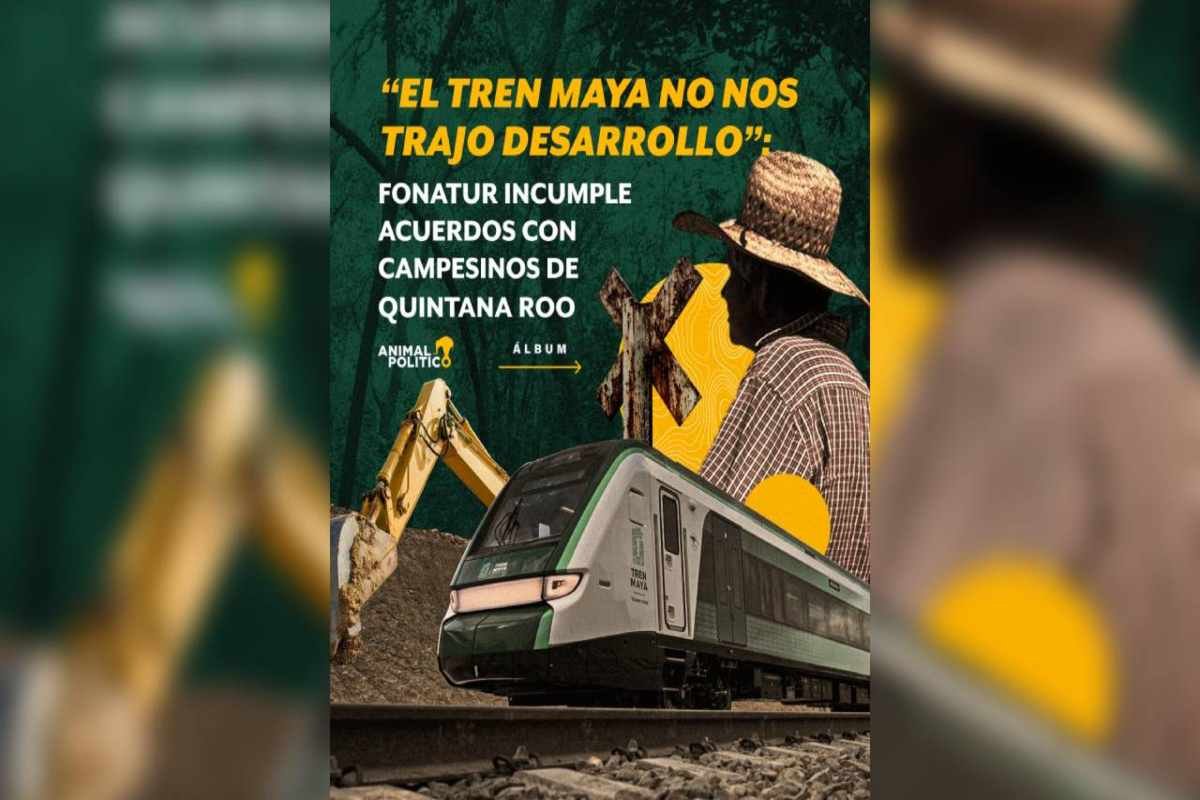
Felipe Carrillo Puerto, Quintana Roo — Farmers from the Felipe Carrillo Puerto ejido are reporting that the Maya Train maintenance base has blocked access to their cornfields and citrus crops. Although the National Fund for Tourism Development (Fonatur) signed an agreement to construct access ramps and harvest roads, it has yet to fulfill its promises.
For the 150 families who have their cornfields and citrus crops surrounding the Maya Train maintenance base in Felipe Carrillo Puerto, Quintana Roo, it has become nearly impossible to access their plots and transport their harvests out. The maintenance base facilities—one of three on the Yucatán Peninsula, with others in Xpujil and Puerto Morelos—include a workshop, an administrative building, a National Guard outpost, and a large, completely empty parking lot.
They were constructed by Fonatur on an embankment of approximately 14 hectares, which is the only access route to the surrounding plots, leaving them sunken a couple of meters below. Furthermore, between the crops and the embankment, Fonatur installed a fence that must be jumped over to enter the cornfields.
"On June 18, 2024, to resolve the problem, Fonatur signed an agreement during an ejido assembly. It promised to build some access ramps to our plots and some harvest roads," said Carlos Koyoc Pacab, president of the Surveillance Council of the Felipe Carrillo Puerto ejido. "However, to date, it has not built anything."
Partial Information During the Indigenous Consultation Process
Between November 15 and December 15, 2019, 15 regional informational and consultative assemblies were held in the five states contemplated for the construction of the Maya Train. Approximately 300 residents of the Felipe Carrillo Puerto municipality gathered in the community of X-Hazil Sur, representing 71 communities.
"At the assembly, they said the Maya Train would bring many benefits, but that was not the case," stated Elías Be Cituk, who was then the ejido commissioner of Felipe Carrillo Puerto. He lamented that the megaproject attracted many military personnel, but no tourists, and, furthermore, generated problems that the authorities did not mention during the assembly.
In fact, according to the Office in Mexico of the United Nations High Commissioner for Human Rights (UN-DH), during the informational stage of the indigenous consultation process, the authorities referred solely to the project's potential benefits and not to the negative impacts.
"During the observed sessions, on various occasions, participating individuals asked about the impacts without obtaining a clear and complete response," the UN stated. "The absence of impact studies or the failure to disseminate them makes it difficult for people to define their position regarding the project in a fully informed manner."
The Consultation, Prior to the Publication of Environmental Impact Studies
Elías Be Cituk also affirmed that on December 15, 2019, during the assembly in X-Hazil Sur, the authorities never presented a copy of the Maya Train's environmental impact studies, nor of the dozens of stone material extraction banks that the Secretariat of National Defense (Sedena) built in Felipe Carrillo Puerto.
"The [impact] studies have not been done, which is why this is only a generic consultation about whether the train will go through or not. Later, specific consultations will be held in the communities about whether there is an impact on the environment and culture," stated Hugo Aguilar Ortiz in December 2019, then coordinator of the Indigenous Rights Program of the National Institute of Indigenous Peoples (INPI) and currently presiding minister of the Supreme Court of Justice of the Nation (SCJN).
However, once the Environmental Impact Statement (MIA) for section 6 of the Maya Train in Felipe Carrillo Puerto was published, no specific consultation was carried out. In the months and years following the December 2019 assembly, the government's approach to the communities was rather focused on making agreements as needs arose. Among them was the agreement that Fonatur signed with the Felipe Carrillo Puerto ejido on June 18, 2024, following the problems that arose from the construction of the Maya Train maintenance base.
Unfulfilled Promises
From the vehicle bridge that crosses the Maya Train tracks, the railway maintenance base appears as a gray stain on a great green canvas, formed by the cornfields and citrus crops. Just below the bridge, where the dirt road that leads to the plots and runs alongside the maintenance base begins, there are barbed wire fences. Carlos Koyoc Pacab says that Fonatur placed them to partially block the passage.
"We are concerned that they will completely close access to this road, which leads to our lands. The train did not bring us development; it was a disappointment for us," said the farmer. "The government did not keep its promises: not only did it not build the access ramps to the plots, nor the bridge to take out our harvests and the wells for irrigation that we had agreed upon. And it still needs to pay for the damages it caused during the works, when it destroyed our citrus plants."
Discover more from Riviera Maya News & Events
Subscribe to get the latest posts sent to your email.