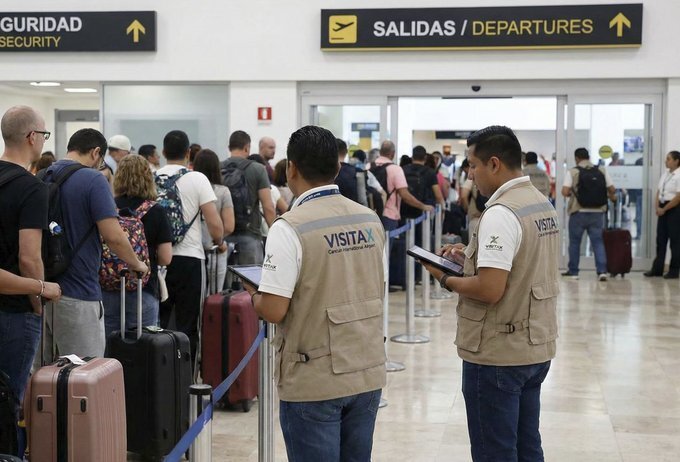
Chetumal, Quintana Roo — Due to the failure to secure hotel participation as intermediaries for collecting the Foreign Visitor Fee (Visitax), following opposition from the hotel sector, the state government expects to collect only one-eighth of the revenue that could be generated if nearly all international tourists arriving in Quintana Roo paid the fee.
According to the ruling on the State Revenue Law for 2026, approved by the State Congress on Wednesday night, the Visitax collection target was reduced from 2.9 billion pesos, which was expected to be collected through hotels, to only 368.162 million pesos, due to the lack of implementation of the change.
The new amount represents only 12.6% of what could be collected with the fee retention in hotels, according to state government projections, equivalent to just one-eighth of the Visitax income potential.
This is practically the same proportion that will be collected in 2025, as Diario Cambio 22 previously reported in a timely manner. In its initiative, the state government mentioned that Quintana Roo received 6,580,424 foreign tourists through Cancún Airport from January to August, so if all of them had paid the Visitax, which this year amounts to 283 pesos, the revenue generated would have been 1.862 billion pesos, close to 2 billion pesos at that time.
However, as of September this year, the state government had only collected 268.079 million pesos from Visitax, according to financial statements published by the Secretariat of Finance and Planning (Sefiplan), representing just 12.7% of the potential amount of 2.1 billion pesos that could have been obtained with payment from almost all foreign tourists arriving by air up to that month.
The reason is that Visitax is a fee with high evasion by tourists, largely due to lack of awareness, and partly due to the direct payment system at airport modules and online, in addition to the proliferation of fake websites that illegally charge Visitax, defrauding tourists, as Diario Cambio 22 reported in a separate article today.
“It is estimated that the total amount of the Revenue Budget for Fiscal Year 2026, as well as the total projected amount, are adjusted downward in the same proportion due to the adjustment to the projection of the Foreign Visitor Fee budget, which from $2,900,000,000.00 (two billion nine hundred million pesos) is adjusted to $368,162,557.00 (three hundred sixty-eight million one hundred sixty-two thousand five hundred fifty-seven pesos),” says the ruling approved last night by the Legislature.
Consequently, with the loss of 2.532 billion pesos in expected revenue, the total expected income from Fees for the Use, Enjoyment, Utilization or Exploitation of Public Domain Assets decreased from 4.307 billion pesos to only 1.775 billion pesos.
Under this concept, the Cruise Passenger Fee is also included, charged to those arriving in Cozumel and Majahual at a rate of 5 dollars per person, so according to information from the ruling, the state expects to obtain at least 1.407 billion pesos from this charge.
It should be mentioned that under the same concept, a Fee for Service Units in Sites Adjacent to Archaeological Zones is considered, but the state has not been able to collect it because it does not have its own facilities at those sites or an agreement with INAH to apply it.
The consequence of the reduction of the original revenue proposal was that the financial ceiling of the expenditure budget also decreased from 56.514 billion pesos to 53.981 billion pesos.
The sector that suffered the largest spending cut was Public Investment, which from an original projection of 3.784 billion pesos ended up at 2.601 billion pesos, meaning it was reduced by 1.183 billion pesos.
The allocation for the Tourism sector also saw a significant reduction, as originally 937 million pesos were to be allocated, but with the cuts, its final amount remained at 681 million pesos, 27% less, which are for the secretariat, the Tourism Promotion Council and the new Tourism Infrastructure Institute, which will handle maintenance of the Cancún Hotel Zone.
The General Branch of Financial Provisions was also adjusted downward, specifically in operational expenses for tourism promotion and beach recovery.
Discover more from Riviera Maya News & Events
Subscribe to get the latest posts sent to your email.