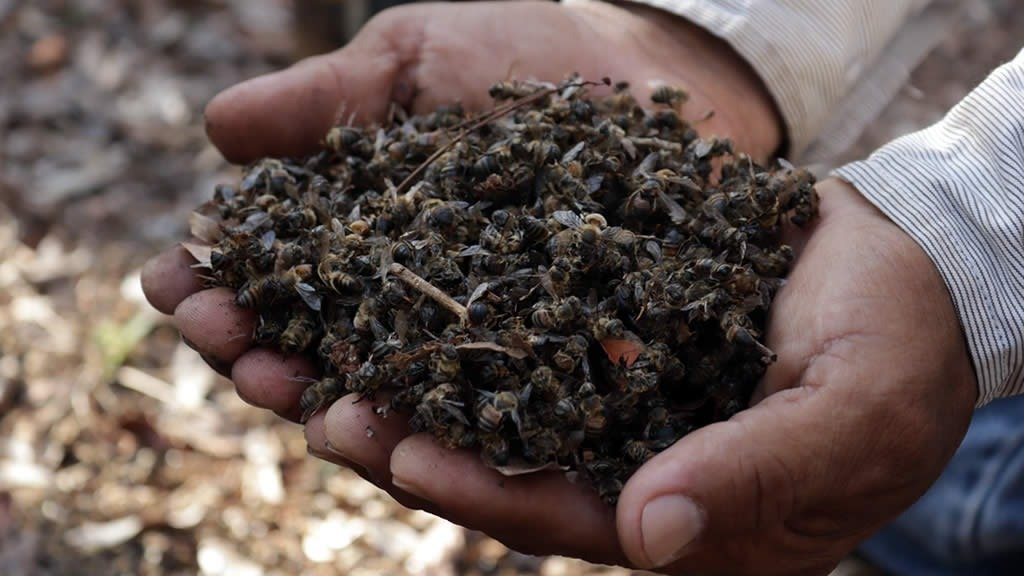
The intensive use of pesticides considered highly dangerous – including fipronil and neonicotinoids (thiamethoxam and imidacloprid) – has caused massive bee deaths in Mexico. From 2013 to 2024, 296,000 hives of Apis mellifera were lost in 15 states, according to a census conducted by Eric Vides Borrel, a doctor of science in ecology and sustainable development and researcher at El Colegio de la Frontera Sur (Ecosur).
One such event occurred in 2023, when beekeeping families in Hopelchén, Campeche, found their apiaries devastated: bees lay lifeless on the ground. The scene was desolate. Subsequently, they requested help from Ecosur researchers to determine the causes behind the massive bee deaths.
The analysis determined that, in total, 110 apiaries belonging to 80 beekeepers were affected. A total of 3,365 hives were damaged, which in turn caused significant economic losses. The affected species was Apis mellifera, used for large-scale honey production.
“We conducted the first quantification of the cost of damages considering the loss of honey, the loss of bees, and the loss of agricultural production – because bees contribute to agricultural production through pollination – and we arrived at an estimate of nearly 13 million pesos in losses,” says Rémy Vandame, a doctor in ecology from the University of Lyon, France, and researcher at Ecosur.
To the Hopelchén case, three more episodes were added in the Yucatán Peninsula: in 2024, in Hopelchén and Tizimín, Yucatán; in 2025 in Tekax, Tabasquito, José María Morelos, Quintana Roo. The recorded cases had a point of convergence: agricultural fields where fipronil is used, a broad-spectrum insecticide with lethal effects on the nervous system of bees.
Dr. Eric Vides Borrel explains to Contralínea that the census showing that, from 2013 to 2024, 296,000 hives of Apis mellifera were lost in 15 states, underestimates what occurs in reality. This is because it was conducted based on interviews with groups of beekeepers, and “we have other states where we know there were poisonings, but we do not know the number of hives.” The real figure could be significantly higher.
Insufficient Decree
Although the head of the Secretariat of Environment and Natural Resources (Semarnat), Alicia Bárcena, recognized the severity of the crisis and announced a strategy to protect pollinators, neither fipronil nor the main neonicotinoids were included in the list of 35 pesticides prohibited by presidential decree this year. The institution did not comment on its participation in the preparation of the decree.
For its part, the Secretariat of Agriculture and Rural Development (Sader) disseminated a technical report listing the 20 pesticides that affect pollinators, of which only five were included in the decree, signed on September 5, 2025.
In a footnote, it is acknowledged that the main culprits of bee deaths are: fipronil, imidacloprid, thiamethoxam, and deltamethrin; however, it explains that “these insecticides are not included in the prohibition decree, since they are a viable option to control various pests of agricultural importance.”
For Dr. Fernando Bejarano, director of the Pesticide Action Network and Alternatives in Mexico (RAPAM), the measure is insufficient. In this regard, he explains: “In Mexico, 35 [pesticides prohibited in the decree] are currently being considered [for prohibition]; but there are still 72 registrations of highly hazardous pesticides that are highly toxic to bees.”
Of those dozens of herbicides, he indicates, “the most notable, due to their higher sales in the country – according to consultant reports – are fipronil, imidacloprid, and thiamethoxam, for which we have evidence that they are causes, especially in the case of fipronil, of high toxicity in bees.”
Dr. Bejarano points out that, unlike Mexico, these substances are prohibited in other countries. Fipronil is prohibited in 49 nations, imidacloprid in 29, thiamethoxam in 28, including countries of the European Union, where its sale is banned for agricultural use in open spaces.
Although for Dr. Rémy Vandame the prohibition of agricultural-use pesticides is not an easy task, he points out that “it is necessary, in the sense that they are highly dangerous [pesticides] and are causing tremendous damage to bees, insects in general, and biodiversity.”
He states that there is currently recognition and reflection at the national and international level “about the damages that pesticides are causing. I would say that, since the green revolution, since the 1960s, the use of pesticides in general has been increasing, with tremendous damages, not only for biodiversity but also for human health. I believe that now there is a global recognition that we do have to move on to something else.”
Fipronil, Poison That Travels with the Wind
In the cases analyzed in the Yucatán Peninsula, the central hypothesis to explain how fipronil traveled to the hives is drift. Dr. Vandame explains that “at the moment an insecticide is applied, it is often applied by tractor, spiders – as they call the application devices – or eventually by small planes – which are being used a lot illegally – but in any case, whatever the application method, almost always a kind of insecticide cloud is generated above the crop field and if there is wind, at that moment the insecticide disperses.”
To have a dimension of the scope, he exemplifies with the case of Hopelchén in 2023, in which it was found that the greatest distance between the affected area and the probable origin of the application was approximately 6 kilometers, “we are talking about 11,300 hectares, where the insecticide applied in one plot was potentially distributed.”
For his part, Dr. Eric Vides indicates that, although there is vast scientific evidence of the ecological damages of pesticides like fipronil, the analysis of damages generated by their secondary metabolites is often omitted. “Once fipronil is applied to crops and released into the environment, due to the action of light, oxygen, or the environment, it decomposes into other molecules; for example, fipronil sulfide, which can continue with a half-life in the soil for up to two years.”
This is relevant because – after announcing the decree prohibiting 35 pesticides, at the presidential conference on September 3 – the head of Sader, Julio Berdegué Sacristán, gave four examples of the prohibited molecules, including DDT.
“DDT is prohibited worldwide since the 1970s; in Mexico for some reason importation was prohibited, but not production or use, who knows how that was possible. Notice that recently we found DDT in samples of bees that died from pesticide poisoning in Soconusco; when analyzing what had killed these marvelous insects, we found that there was, among other things, DDT,” said Berdegué.
According to scientific studies, and like fipronil, DDT has a prolonged survival time in the environment, which can range from 2 to 15 years. This could explain why the pesticide is still found in the environment, says Erica Hagman Aguilar, a biologist from the National Autonomous University of Mexico and independent researcher. This pesticide, she explains, “is highly persistent. So, even when it is not used, DDT will continue to be found.”
For his part, Vides Borrel insists on the need to “study the effects on bees of these secondary metabolites.” He criticizes that the topic is always fipronil and there is no in-depth analysis, despite the fact that “there is scientific evidence in other regions where it is shown that some of the secondary metabolites of fipronil can be even more toxic than fipronil itself for certain groups of organisms.”
He also highlights the case of AMPA (aminomethylphosphonic acid), a secondary metabolite of glyphosate, which can be “more toxic than glyphosate itself.” According to the study Glyphosate and the metabolite aminomethylphosphonic acid (AMPA) modulate the phenotype of murine melanoma B16-F1 cells, glyphosate increases aggressiveness characteristics in cancer cells: reduces their adhesion, increases their ability to migrate, induces the production of extracellular vesicles, and activates the ABCB5 gene, related to drug resistance for cancer.
However, AMPA is even more toxic than glyphosate and caused signs of DNA damage. The study concluded that AMPA could be especially harmful to healthy cells, while glyphosate could enhance metastatic characteristics in tumor cells. Although it also points out the need for more research to understand how humans could be affected.
Researcher Vides Borrel considers that “if risk assessments are only made on the molecule that is sold and not on the secondary metabolites, we are having a very partial understanding of the effects of the release of these substances into the environment once they degrade into other molecules.”
Apis Mellifera as an Indicator of Environmental Health
The massive death of bees is an indicator that “the health and permanence of ecosystems could be at risk, since about 87.5 percent of flowering plants (angiosperms) depend largely on pollinators for their reproduction,” says Dr. Angélica Cervantes, deputy director of Information Management and Species Assessment of the National Commission for the Knowledge and Use of Biodiversity (Conabio).
In the cases described so far, the species Apis mellifera was taken as a reference, because the researchers consulted by Contralínea explained that, being a species found in apiaries under the care of beekeepers, it is they who report any detected anomaly. In contrast, with native bees “it is different, because they are dispersed in the forest, nest in trees, in the ground, in branches, in different supports and are not so concentrated in one place,” details Dr. Rémy Vandame.
Nevertheless, the fact that one species is presenting a situation of massive mortality is already an indicator that other species, even from other families, would be affected. “Without any doubt, if Apis die, all native bees and other insects also die, only we have no way of seeing it, because it is not so easy to prove. There is no reason not to think that if Apis mellifera die, the other insects also die. They function in the same way and although we cannot prove it, we can assume that they do die,” adds the scientist, researcher at Ecosur.
In turn, Dr. Angélica Cervantes Maldonado laments that knowledge about native bees is limited, “despite the fact that Mexico has approximately 2,000 species, representing 10 percent of the world total.”
In Brazil, research on pesticide resistance in three bee species determined that, compared to native bees, Apis mellifera has greater resistance to certain substances. The study Substitute species in pesticide risk assessments: toxicological data of three stingless bee species analyzed the species: uruçu (Melipona scutellaris), jataí (Tetragonisca angustula), and mandaguarí (Scaptotrigona postica), and revealed that the two native species are more sensitive to the pesticide thiamethoxam (TMX) than Apis mellifera (a stinging species introduced in the country and adopted as a toxicological testing model for the approval of agricultural pesticides).
In the Mexican case, damage to native species is already documented with the most recent poisoning and massive bee death, which took place between September and October 2025 in Tabasquito, José María Morelos, Quintana Roo.
Ecosur researchers recorded damage in at least 2 meliponaries and nine apiaries; among them, a group rural development apiary, where not only the death of 164 hives of Apis mellifera was reported but, for the first time, the loss of 10 hives of Melipona beecheii, a native species of Mexico and considered “the sacred Mayan bee,” was recorded.
The report presented by the team studying bees at Ecosur describes that, “due to the time elapsed between the poisoning and the sampling of the bees, laboratory analyses did not allow identifying the molecule responsible for the bee deaths.” However, based on the symptoms presented, a direct relationship with pesticides was established.
The loss of native bees has a pact not only biological but cultural. Dr. Angélica Cervantes Maldonado warns that in this case the impacts are significant on biodiversity and food security. This is because “unlike the honey bee, these can be selective of the type of flower they pollinate; that is, pollination can be very specific and their disappearance could impact the reproduction of key species for ecosystems and affect food security.”
The problem of pesticides does not only conclude with the immediate extermination of bees, but those that do not die at the moment can face prolonged effects before causing their death. “When bees are exposed to a low dose, they do not die, but the insecticide can affect their mobility, their flight, their ability to orient themselves in the field, their immunity, and even their fertility. There are a series of effects that pesticides have before death,” warns Dr. Rémy Vandame.
To dimension the effect that the continuous loss of hives would have, the deputy director of Information Management and Species Assessment of Conabio, Angélica Cervantes Maldonado, emphasizes that “Mexico has 21,843 species of flowering plants, of which approximately 85 percent depend to some degree on the pollination service provided by animals.”
She cites the article Pollinator-dependent food production in Mexico – published in Pollinator dependent food production in Mexico in 2009 – to highlight that “it has been estimated that 425 plant species are used in some way by humans and 171 species are used exclusively for the production of fruits and seeds; 145 of these are species dependent on pollinators.”
Agroindustry: The Model That Triggers the Crisis
Behind the cases of massive bee deaths related to pesticide use, there is also another common factor: agroindustry. The Yucatán Peninsula is a clear example of this, because it has been the territory used for the implementation of monocultures and the planting of transgenic crops and their technological packages – as the industry calls them – which include the use of pesticides like glyphosate.
The problem of agroindustry in the state is that “it is based on a whole model of large-scale production of monocultures, in some cases transgenic,” explains Jorge Pech, a member of the Maya Collective of the Chenes, in an interview.
He denounces that these forms of land production “involve large extensions, large polygons of territory that brings as a consequence the increase in deforestation, the use of pesticides, and the loss of vegetation cover, which impacts negatively not only on Apis mellifera bees but also on native bees like meliponines, Scaptotrigona, Nannotrigona perilampoides, which are in the jungle and currently face a decline due to this unregulated and unethical model.”
The arrival of transgenics to the region came officially in 2012, in the last stretch of Felipe Calderón’s government, when the National Service of Agrifood Health, Safety, and Quality (Senasica) granted a permit to the transnational Monsanto for the experimental phase release of transgenic soy. However, the legal framework was given since Vicente Fox’s administration with the issuance of the Biosafety Law of Genetically Modified Organisms.
In this regard, Jorge Pech declares that “these technologies are mostly handled by Mennonite communities that obtain these facilities, these technological packages [transgenics] that are also provided by businessmen.”
At the presidential conference on September 29, 2025, the head of Semarnat, Alicia Bárcena, recognized that “one of the most risky zones we have identified is the Yucatán Peninsula, where unfortunately the Mennonites are deforesting and we have detected planting of transgenic corn because of that, we are closing many zones in the Yucatán Peninsula.”
According to data from specialist Rémy Vandame, in the last 30 years due to deforestation “9 percent of the Mayan jungle has been lost. This great jungle that covers the Yucatán Peninsula and the Petén, in northern Guatemala, which is the second forest massif in America after the Amazon.”
Deforestation is linked to neoliberal policies especially after the reform to Article 27 of the Constitution in 1992, promoted by Carlos Salinas de Gortari. This ended land distribution and allowed the buying and selling of ejidal lands, opening the countryside to private capital and the land market. All this, in line with the entry of the North American Free Trade Agreement (NAFTA).
Deforestation has occurred through land use change – in most cases illegally. The Federal Attorney for Environmental Protection (Profepa) reported that in Yucatán, 17 properties were closed due to illegal land use change.
In a statement, it detailed that from June 15 to August 31, 2025, Profepa carried out 17 inspection operations in forest properties in Campeche, Quintana Roo, and Yucatán, with the support of the National Guard, the Secretariat of National Defense, and state security corporations. And that clearings and land use changes without authorization from Semarnat were observed, which resulted in the closure of the 17 properties where the jungle was razed for the planting of agroindustrial monocultures, mainly by Mennonite communities.
Even though Profepa closed said sites, the specialist and master in constitutional law from the Division of Postgraduate Studies of the National Autonomous University of Mexico (UNAM), Raymundo Espinosa Hernández, explains that sanctions for this type of practice are usually administrative. And in any case, economic fines will be imposed.
“The truth is that I have never seen anything happen” against those who are deforesting, warns the expert. He adds that these admonitions do not take into account the integral reparation of damage for the affected population. “It would be very good if it could also be linked to the reparation of damage for those people; for example, those whose other crops have been contaminated with traces of transgenics, passing through the issue of honey, the same also. Those who have suffered damages or losses precisely due to transgenic contamination should be compensated.”
Meanwhile, Jorge Pech laments that despite it being several years since communities have denounced what authorities now recognize, their action is late. And for researcher Érica Hagman, Profepa should have conducted the reviews constantly to avoid reaching deforestation.
Nevertheless, Secretary Alicia Bárcena assured that the planting of transgenic soy is not a concern for the country, because Mexico is not the center of origin of that seed, even though there are other damages related to its production.
Under that context, researchers express their concern about the lack of coordination between Semarnat, Sader, and Cofepris – and the absence of a real system of traceability of agricultural applications –, as it has allowed substances prohibited in other countries to continue being used without effective controls in Mexico.
Dr. Bejarano and independent researcher Érica Hagman agree on the need to develop a traceability system. This is because highly hazardous pesticides are used intensively throughout the national territory, and there are no data that allow specifying in what quantities and in what specific places they are being applied, as well as the final disposal sites of the residues. Despite the fact that these must have special management.
Only in 2019, the National Institute of Ecology and Climate Change published the Diagnosis on pesticide contamination in surface water, groundwater, and soil, in which it concluded that in 23 states of the Republic there are 125 sites with pesticide contamination in surface water, groundwater, or soil, the highest concentration is located in Campeche, Guerrero, and Sinaloa.
In this regard, Dr. Vides Borrel recommends conducting analyses that allow determining in which sites there is a lower level of risk for pesticide use. This, by considering the type of soil on which there is application. “It is known that fipronil has a half-life in soil of more than 120 days, ranging from 120 to 130 days, it is known that in clay loam soils it is more persistent than in sandy soils.”
These criteria, he indicates, should be considered to “in any case regionalize where its use would be less harmful.” This, while an integral strategy of transition towards a more sustainable agricultural production system like agroecology is outlined.
Meanwhile, Dr. Vandame calls for immediate actions to be taken. And he considers that “there is good will from Semarnat,” but that “it is necessary to move to a much more active level of discussion to make strong decisions because the urgency is today, not for years from now.”
Activist Jorge Pech reiterates that what is happening with bees is an alert for the environment and human health. “They are indicating to us that something is failing or something is wrong and here we realize how the residues of these pesticides that are finishing off the bees at some point are going to affect our human health, even this is an issue that is not being looked at and that we do not see an interest from the authorities in charge of the health issue to regulate.”
Therefore, he also asks for real attention with intersectoral participation, “that is why I was talking about there should be a triangulation between the secretariats to address the issue in an integral way.”
Discover more from Riviera Maya News & Events
Subscribe to get the latest posts sent to your email.