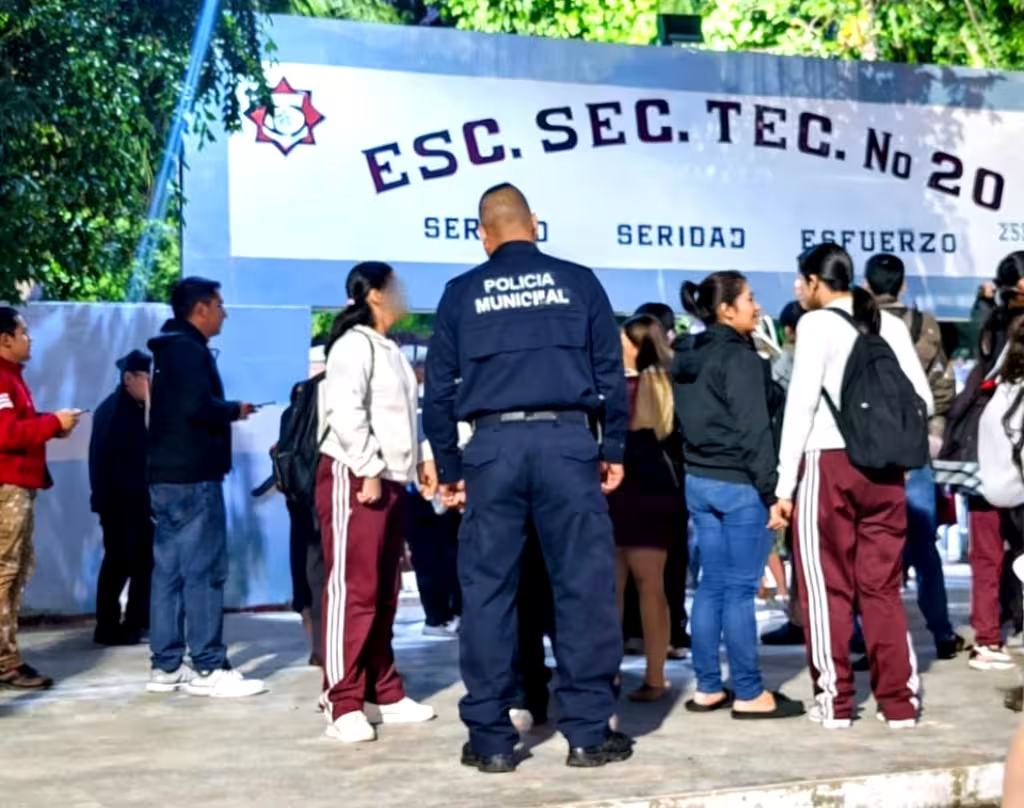
Cancún Parents Expose School Bullying Crisis
Cancún, Quintana Roo — Parents in Cancún have warned that the school environment is marked by bullying, verbal aggression, and in some cases, physical violence. In a survey conducted by POR ESTO! among guardians of basic education students, at least three out of 10 acknowledged that their children have been victims or witnesses of some type of violence in the classroom.
“My son has suffered constant teasing about his way of speaking and dressing, which caused him anxiety and now he doesn’t want to go to school. Another classmate is teased because he’s chubby, and that’s also violence,” said Laura N., mother of a middle school student.
Other parents reported cases of insults, threats, pushing, including incidents on social media, forms of aggression that are often minimized by school authorities.
The common denominator was that school violence is no longer limited to the classroom, but has moved to cell phones and social media, seriously affecting students.
“My daughter hasn’t been attacked, but a classmate has who is insulted every day on WhatsApp. They send her messages saying nobody likes her and she should change schools,” said the mother of a middle school student.
In the same vein, Gilberto L., a parent, stated that his son talks at least twice a week about constant aggression against a classmate.
“He tells me they treat him badly, they make fun of him in front of the group. Although they don’t hit him, they make him cry and he hardly participates in class,” he said.
Another mother noted that digital violence has worsened the problem: “Now bullying continues after school. I’ve seen screenshots of messages where they threaten each other or there’s foul language. Teachers don’t always know how to intervene.”
For Claudia R., mother of a first-year middle school student, the problem is that many cases aren’t reported.
“Children are afraid to speak up because then they’re attacked more. I know of at least two cases where chat groups are used to make fun of a single student,” she asserted.
Ana S. warned that verbal violence has become normalized: “Insults, teasing, and offensive messages are now seen as something common. That gradually damages children’s self-esteem and nobody seems to stop it in time.”
Parents agreed that this type of violence, although it doesn’t always leave physical marks, deeply impacts students’ emotional health and urged educational and municipal authorities to strengthen prevention strategies, psychological support, and case follow-up, beyond symbolic actions.
High Incidence
According to recent data, Mexico ranks among the top countries for school bullying in basic education among members of the Organisation for Economic Co-operation and Development.
The National Human Rights Commission (CNDH) stated that seven out of 10 children have been victims of this problem.
For its part, the Secretariat of Public Education estimates that around 40% of basic education students have suffered bullying, while in Quintana Roo dozens of formal complaints are registered each year, although there’s presumed to be high underreporting due to fear of retaliation or distrust in protocols.
Today marks the School Day of Non-Violence and Peace (DENIP), an international educational day established by the United Nations Educational, Scientific and Cultural Organization (UNESCO) since 1993, with the goal of promoting values like tolerance, respect, dialogue, and peaceful coexistence in educational centers.
However, beyond symbolic acts, the reality experienced by thousands of students in Cancún’s classrooms shows that school violence remains a serious and persistent problem.
Discover more from Riviera Maya News & Events
Subscribe to get the latest posts sent to your email.