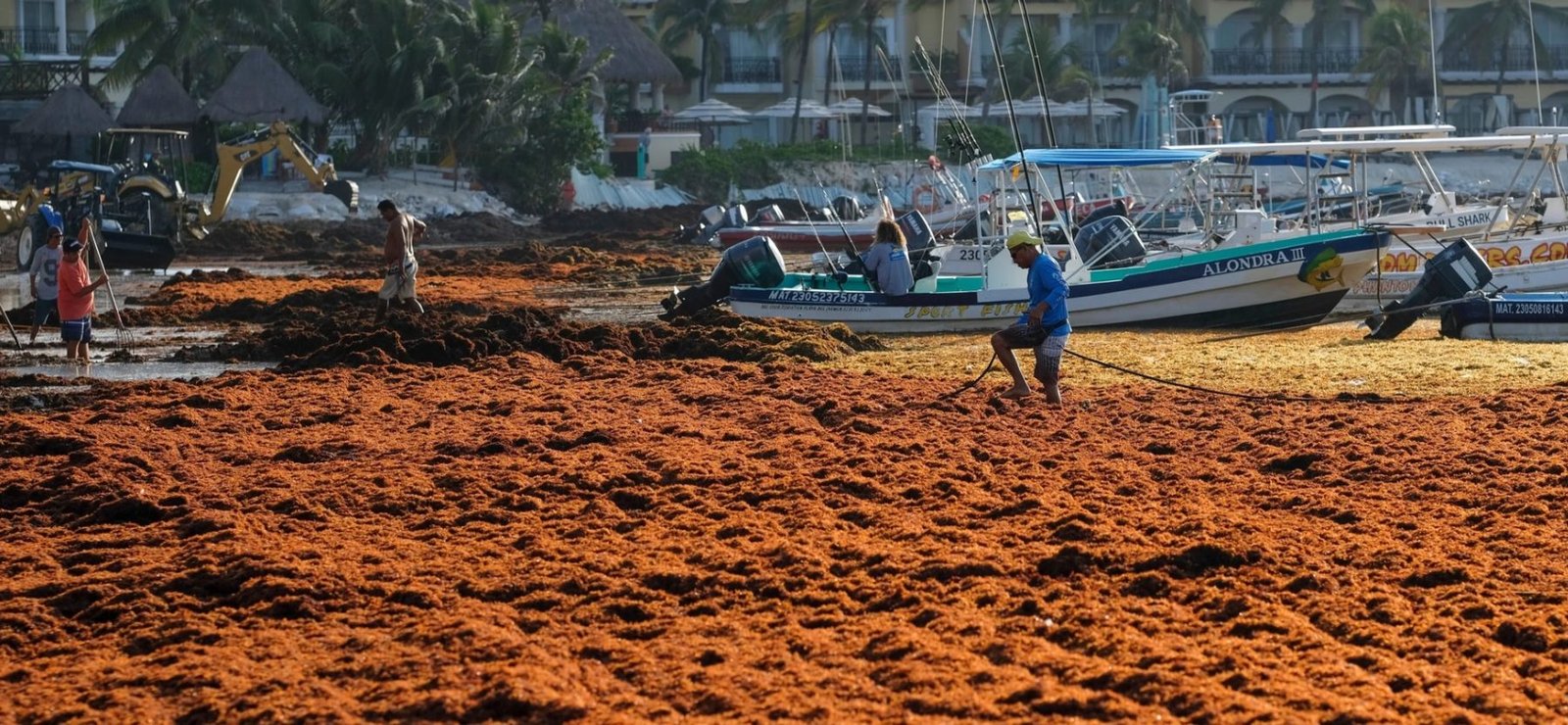
Mexico City — Federal measures to combat sargassum are insufficient to handle the massive seaweed influx forecast for 2026, according to opposition lawmaker Ernesto Sánchez, as Mexico’s Caribbean coast prepares for one of its worst recorded seaweed seasons.
The National Action Party (PAN) deputy warned that the institutional response remains reactive and fragmented despite sargassum becoming a predictable, recurring problem. “The reality is that the sargassum phenomenon has stopped being an atypical event; today it’s a structural, recurrent and predictable problem,” Sánchez said. “However, the institutional response continues to be reactive, fragmented and without a comprehensive long-term strategy.”
He noted this has caused Quintana Roo’s beaches to be overwhelmed year after year, directly affecting the Mexican Caribbean’s tourism image and the economy of thousands of families who depend on the sector.
The lawmaker emphasized that tourism is one of the main economic engines for both the state and the country. When beaches are saturated with sargassum, it not only affects visitors’ experience but also damages Mexican destinations’ international competitiveness against other Caribbean markets.
“What we’ve seen until now are isolated actions: insufficient barriers, late collection and lack of effective coordination between federal, state and municipal governments,” Sánchez stated. “There’s no permanent fund with clear rules, nor a robust program for industrial use of sargassum that would turn it into an economic opportunity instead of an environmental liability.”
He demanded that sargassum management include fundamental elements like scientific planning with permanent monitoring using satellite technology and predictive models, sufficient budget allocation for marine infrastructure and specialized machinery, and promotion of a circular economy to transform sargassum into productive inputs.
“Quintana Roo cannot face alone a phenomenon that has an international character,” Sánchez asserted. “Federal leadership, strategic vision and real resources are required. Today, unfortunately, the federal government has been overwhelmed, and those who pay the consequences are tourism workers, small business owners and Quintana Roo families.”
In contrast, Morena party deputy Luis Humberto Fernández rejected claims that sargassum puts tourism at risk in the state, though he acknowledged it presents a challenge for all three levels of government since predicting the exact quantity that will arrive remains difficult.
Fernández recalled that since sargassum began arriving in the state, the federal government implemented strategies, and starting in 2018, the Mexican Navy intervened and established coordination mechanisms between federal, state and municipal governments.
The Quintana Roo legislator assured that very specific coordination already exists between the three levels of government that has gradually been refined. Now, he said, officials only need to determine whether to expand or adjust efforts based on how much sargassum arrives.
“What I see is that we just need to adjust or intensify according to how the quantity of arriving sargassum presents itself,” Fernández explained. “It’s like hurricanes: you have the threat, but you don’t know if it’s going to arrive or not, where it’s going to hit and with what intensity. It’s a little bit like that.”
The federal deputy indicated that an interinstitutional agreement currently exists involving the Tourism Secretariat in aspects like sargassum and tourist attention schemes, areas where World Cup matches will be held and where teams will train, as well as review of hotel infrastructure and mobility.
“Mechanisms are in place to contain and treat the arrival of sargassum,” Fernández reiterated. “We don’t believe it’s a factor that will inhibit tourism here in Quintana Roo. It continues to be a challenge and will be until sargassum decides to impact somewhere else or leave the sea so copiously… but it’s not something that cannot already have been treated at an important level and won’t continue to be treated that way so it could represent a risk.”
Discover more from Riviera Maya News & Events
Subscribe to get the latest posts sent to your email.