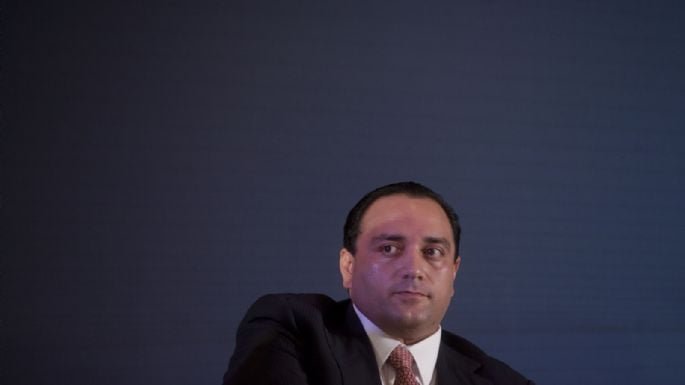
PLAYA DEL CARMEN, Quintana Roo — Currently imprisoned in Morelos, former Quintana Roo governor Roberto Borge Angulo has been declared the leader of a criminal network. This ruling positions the PRI politician to face up to 40 years in prison after squandering state real estate assets, causing damage to Quintana Roo’s treasury estimated at over 900 million pesos.
The former governor was arrested in June 2017 in Panama, from where he planned to flee to Europe. He is accused of various crimes including embezzlement and money laundering, allegedly committed during his public service as governor from 2011 to 2016.
The Attorney General’s Office (FGR) successfully overturned an indictment issued by a control judge at the Federal Justice Center in Almoloya, State of Mexico, which had classified him as a subordinate in the criminal organization that during his administration sold 22 properties belonging to the state.
The criminal network was woven between former public servants and relatives of Roberto Borge, who acted on his behalf and served as front men for shell companies that purchased the properties at prices well below their actual market value.
Some of these properties are located in privileged sites near beaches in Quintana Roo’s tourist zones.
The Collegiate Appeals Court in Xochitepec, Morelos, issued a new ruling that places Borge Angulo as the leader of this criminal organization, as the FGR was able to prove that it was the former state governor who, from his position of power, gave orders to alienate 22 properties that represented a loss to the treasury of 900 million 99 thousand 418 pesos.
“Among his powers was that of possessing, monitoring, conserving, and administering the assets of that federative entity’s patrimony; indeed, precisely because of his position in public administration, he had access to privileged information, knowing the State Development Plan, which logically allowed him to identify where future investments and developments would be made and to have knowledge of tourist and hotel developments,” reads criminal case file 269/2024, consulted by Proceso.
Flight Risk
With the reclassification of his new legal situation, if found guilty, Roberto Borge faces a sentence of up to 40 years in prison, as established by the Federal Law Against Organized Crime for those who lead these criminal organizations, an argument presented by the FGR before the Xochitepec magistrates.
Roberto Borge’s defense had been seeking for over a year to have his client transferred to the Cancún prison to face his criminal proceedings there.
However, the Collegiate Appeals Court in Xochitepec determined that he must continue to be held at the Federal Center for Psychosocial Rehabilitation in Ayala, Morelos (Ceferepsi).
This is because the former governor’s confinement in the low-security Cancún prison would favor the defendant to potentially escape.
“Because he has economic means to secure differentiated treatment for himself or eventually be aided by inmates for an escape (…) this economic capacity could also be a risk for the defendant (…) since third parties directly or indirectly affected in the development of the criminal proceedings could take advantage of this medium or low security of the place of confinement to attempt against the defendant’s life,” adds the criminal case file.
Other Involved Parties
Not only the former governor is implicated in this squandering of real estate assets. The consulted files include Claudia Romanillos Villanueva, former director of the defunct Institute of Real Estate Patrimony of the State Public Administration (IPAE), as she was responsible for signing deeds in favor of third parties.
The whereabouts of this former official are unknown; however, she has promoted various amparo lawsuits and other administrative proceedings to avoid arrest and nullify responsibilities as a public servant.
In its August 2024 issue, Proceso revealed that one of the beneficiaries of these properties was Julia Abdalá Lemus, romantic partner of Manuel Bartlett, former director of the Federal Electricity Commission (CFE) during the administration of Andrés Manuel López Obrador.
According to a real estate folio in her name consulted in the Public Registry of Property and Commerce of Quintana Roo, Julia Abdalá received a property in 2013 in the coastal zone of Puerto Morelos, in the heart of the Riviera Maya.
The transaction value for the 3.8-hectare property was zero pesos, in a location where tourist villas now stand.
The other mode of operation, according to the judicial resolution, was through front men in favor of the former state governor who established shell companies, to which they sold various properties at extremely low prices.
In its arguments to charge Borge before the control judge, the FGR attributed to the former governor that he placed “people close to his family and social circle in key positions, which allowed him to carry out those illicit alienations to benefit the criminal group to which he belongs,” argued the FGR to charge Roberto Borge before the control judge.
In January, it will be eight years since Borge Angulo’s confinement in the Ceferepsi in Ayala, Morelos.
Last January, two properties in Cozumel that had been embargoed since 2018 were returned to the former governor, who appears as co-owner.
Two years ago, there was talk of the possibility of obtaining the benefit of house arrest, a situation in which another former Quintana Roo governor, Mario Villanueva Madrid, sentenced for drug trafficking, finds himself.
But with the resolution of the Collegiate Appeals Court of Morelos, it appears that Borge will face his imminent trial from prison.
Discover more from Riviera Maya News & Events
Subscribe to get the latest posts sent to your email.