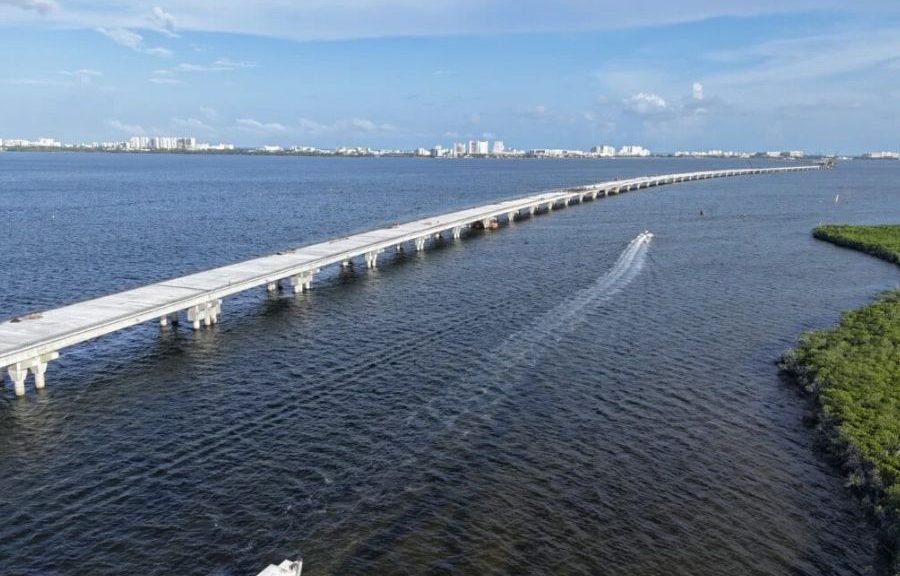
Cancún, Quintana Roo — The Nichupté Bridge project has entered its final finishing and load-testing phase, with construction 94% complete and an opening expected between late March and early April 2026, according to the federal Infrastructure, Communications, and Transport Secretariat (SICT) and state officials.
Unlike the traditional road network in Cancún’s Hotel Zone, the bridge will operate as a regulated public transport corridor managed by the Quintana Roo Mobility Institute (IMOVEQROO). The strategy aims to ease traffic on Kukulcán Boulevard by shifting passenger loads to the new route.
Transport System Details
The corridor will feature hybrid buses with capacity for 70 passengers, designed to reduce carbon emissions in the lagoon environment. Two confirmed routes include:
- The Kabah Axis, connecting the north-central area to kilometer 13 of the Hotel Zone.
- The Las Torres Axis, providing direct access for a high-density residential area currently lacking fast connections to the tourist sector.
Officials estimate the system will handle 15,000 daily users, significantly reducing private vehicle use for work commutes.
Engineering and Urban Design
The 11.1-kilometer structure includes 8.8 kilometers of viaduct over the lagoon, with the remainder consisting of connecting ramps. It features:
- Three 3.5-meter-wide lanes, with the center lane reversible using smart signage to alternate direction during peak hours (morning toward the Hotel Zone, afternoon toward the city).
- A 9.2-kilometer segregated bike path with autonomous LED lighting for safe cycling and pedestrian use.
- Emergency bays at intervals to prevent obstruction from mechanical failures, as the viaduct lacks continuous shoulders along its entire length.
Environmental Protection Measures
Because the project crosses the Nichupté Mangrove Flora and Fauna Protection Area, builders used the “Top-Down” construction method, placing beams and columns from above to avoid heavy machinery directly impacting the lagoon floor. Environmental restoration efforts include:
- Protection of 1,100 specimens of protected plant species.
- Relocation of 2,100 individual animals (reptiles and small mammals).
- Rehabilitation of 118 hectares of seagrass beds in adjacent areas to compensate for the space occupied by support pilings.
Discover more from Riviera Maya News & Events
Subscribe to get the latest posts sent to your email.